Add decision resolution before an agent output is used downstream
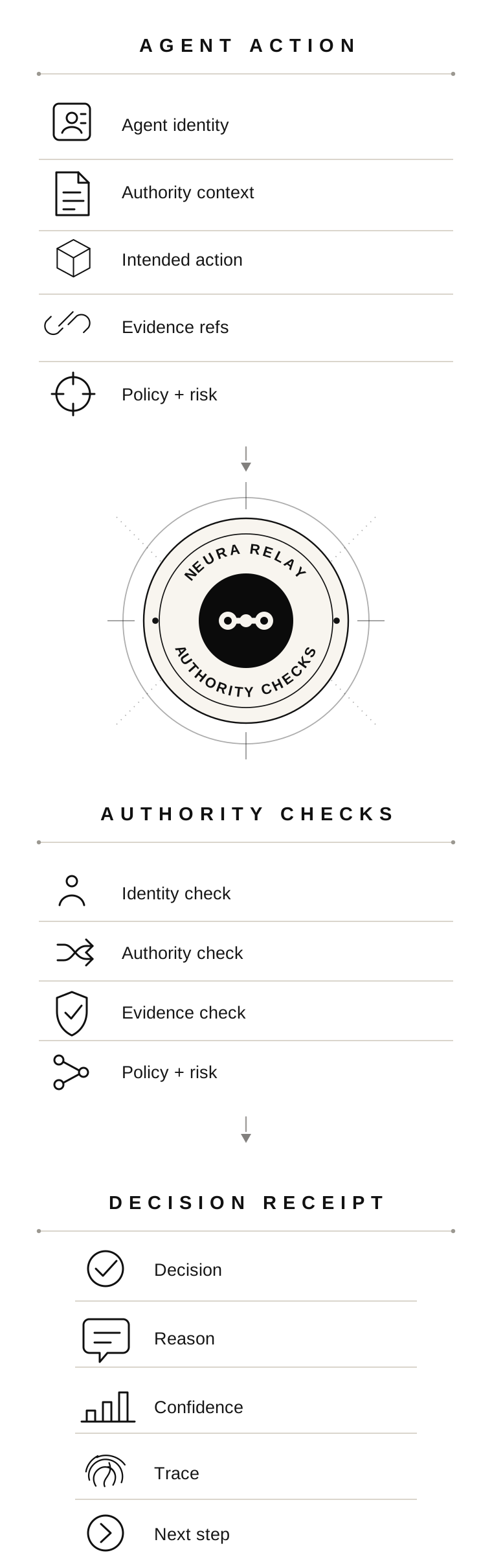
Neura Relay sits between agent output and execution. It returns a governed result that is easier to inspect than a single raw answer: a final decision state, a reviewed output, a rationale, a score, a confidence range, and a trace.
Submit the exact text an agent is about to hand off downstream.
Receive decision, reviewed output, rationale, resolution score, confidence, and structured trace.
needs review, revised, ready
Resolve first, execute second
The public surface is deliberately simple. Submit the output. Resolve it before execution. Consume a governed result that is easier to inspect than a single raw model answer.
Submit an agent output
Pass the exact text an agent is about to hand off downstream.
Resolve before execution
Neura Relay challenges the output, audits the reasoning path, and assigns a final decision state.
Receive the governed result
The response includes a decision label, reviewed output, rationale, resolution score, confidence range, and structured trace.
Three outcomes, one governed surface
These three states are the public proof surface. They show whether an output should stop, change, or move forward before another system acts on it.
Needs review
The output should not move downstream yet because the system found enough uncertainty, missing conditions, or operational risk that a human should inspect it first.
Revised
The original output was directionally useful, but not safe enough to use as-is. Neura Relay returns a reviewed version that adds the missing conditions before anything moves forward.
Ready
The output held up under review and can move forward without material change. This is the approval path for low-risk, already-sound outputs.
Use the current minimal client
The current repo includes a minimal @neurarelay/sdk surface around resolve(). Start with the Playground to understand the decision states, then call the same governed surface from your own code.
resolve({ prompt: string })
decision, reviewed_output, rationale, resolution_score, confidence, and trace
Use this when you want a clearer execution boundary between model output and downstream action.
import { resolve } from "@neurarelay/sdk";
const result = await resolve({
prompt: "Reply that we accept the offer",
});
console.log(result.structured.decision);
// revised
console.log(result.structured.reviewed_output);
// Reply that we are open to the offer, but need final confirmation...
console.log(result.structured.rationale);
console.log(result.structured.resolution_score);
console.log(result.structured.confidence);
console.log(result.structured.trace);The current public contract
The protocol defines the current execution surface behind the public site: Tasks, Runs, trace persistence, message kinds, and the execution modes used by the current Relay implementation.
The immutable prompt unit. A task can have multiple runs.
A single execution instance for a task. Current modes are stub, single, and structured.
Each run persists score, confidence, outcome status, report payload, and a trace hash for tamper-evident inspection.
request, response, challenge, audit, resolution
POST /api/resolve
Content-Type: application/json
{
"prompt": "Reply that we received the document and will review it today"
}{
"ok": true,
"prompt": "Reply that we accept the offer",
"single": {
"decision": "revised",
"reviewed_output": "Reply that we are open to the offer, but need final confirmation on price and timing before accepting",
"rationale": "The original output moves too quickly toward commitment.",
"resolution_score": 39,
"confidence": { "low": 8, "high": 70 }
},
"structured": {
"decision": "revised",
"reviewed_output": "Reply that we are open to the offer, but need final confirmation on price and timing before accepting",
"rationale": "The original output moves too quickly toward commitment.",
"resolution_score": 72,
"confidence": { "low": 48, "high": 96 },
"trace": [
"Inspect output",
"Challenge assumptions",
"Audit reasoning",
"Produce reviewed output"
]
},
"delta": 33
}What is public now, and what is still internal
The public surface today is the Playground, the minimal SDK contract, and the current protocol summary. The deeper arbitration logic, calibration strategy, and full production hardening path remain internal.
What developers can use right now
The site, Playground, SDK, and current protocol summary all describe the same governed surface.
Playground
Use the public Playground to inspect the three core proof cases and test nearby prompts.
SDK
The current repo ships a minimal @neurarelay/sdk client for submitting prompts to /api/resolve.
Protocol v0.1
The protocol defines Tasks, Runs, trace persistence, message kinds, and the execution modes used by the current Relay surface.
Traceability
Every run persists a trace row with score, confidence band, outcome status, reviewed output, rationale, and a trace hash.